
Wholesale 100% Natural Sulforaphane with High Conversion rate, Stability and Clinical Trials Suppliers, Service

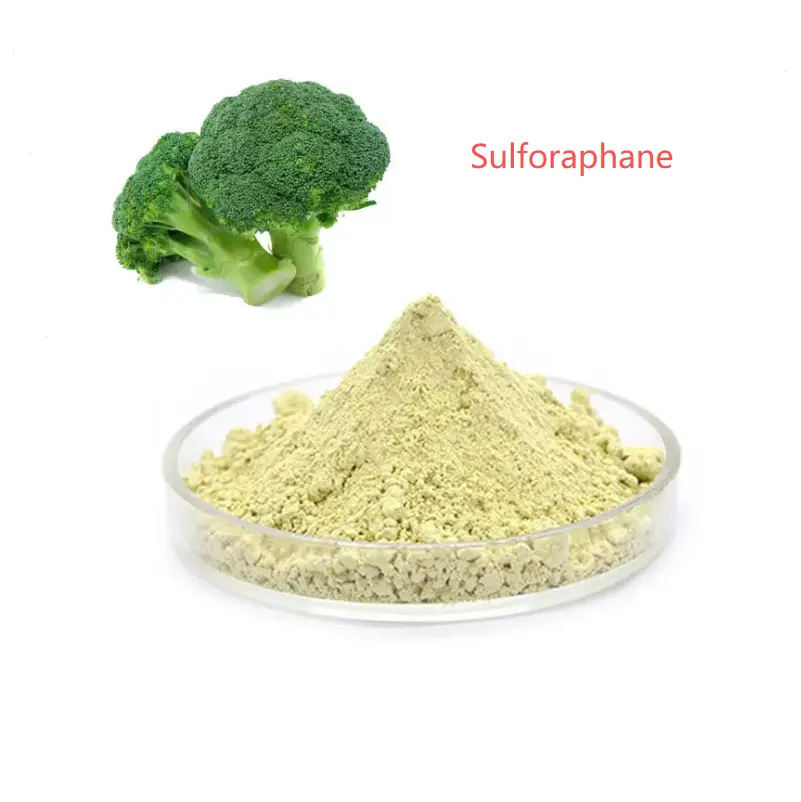
Sulforaphane is an isothiocyanate that does not exist directly in fresh vegetables. When we chew or when vegetable cells are broken, an enzyme called myrosinase hydrolyzes its precursor, glucoraphanin, to produce sulforaphane. Chemically, it has the molecular formula C₆H₁₁S₂NO and appears as a yellow or colorless liquid at room temperature. It is insoluble in water but readily decomposes under high temperatures and alkaline conditions.

Product Description

Features Icon
FEATURES

Cancer-fighting potential: This is the area receiving the most attention regarding sulforaphane. Research suggests it may play a role at multiple stages of cancer development, including inhibiting tumor growth by regulating the cell cycle and promoting apoptosis in cancer cells. A 2025 study revealed that sulforaphane can also enhance anti-tumor immune responses by covalently modifying key proteins. Epidemiological studies consistently show that regular consumption of vegetables rich in this compound is associated with reduced risks of various cancers.

Antioxidant and anti-inflammatory properties: Sulforaphane exhibits antioxidant activity far exceeding that of many common antioxidants. Studies indicate its antioxidant capacity is 20 times greater than quercetin and 80 times greater than curcumin. Additionally, it suppresses the production of inflammatory factors by modulating signaling pathways such as NF-κB. As a result, it shows promising applications in neuroprotection and managing chronic inflammation.

Application Icon
APPLICATION

Cardiovascular health: Animal studies have shown that sulforaphane can improve ventricular remodeling after myocardial infarction.

Mental health: Due to its antioxidant and anti-inflammatory properties, sulforaphane is being investigated as a potential adjunct therapy for mental disorders such as schizophrenia and autism.

Wound healing: Its antimicrobial and anti-inflammatory properties make it a promising candidate for promoting wound healing.
Service Icon
SUPPORTING SERVICE
Frequently Asked Questions
What is the primary source of Sulforaphane?
Sulforaphane is a natural plant compound found in many cruciferous vegetables like broccoli, cabbage, cauliflower, and kale. It is particularly highly concentrated in broccoli sprouts.
How does Sulforaphane compare to other antioxidants?
Research indicates that sulforaphane's antioxidant capacity is significantly higher than many well-known compounds, being approximately 20 times more potent than quercetin and 80 times more potent than curcumin.
Can Sulforaphane support heart health?
Yes, studies suggest it can improve ventricular remodeling after myocardial infarction and protect the cardiovascular system through its anti-inflammatory effects.
Is Sulforaphane beneficial for mental health?
Emerging research is investigating sulforaphane as a potential adjunct therapy for conditions like autism and schizophrenia due to its ability to reduce neuroinflammation and oxidative stress in the brain.
Does it help with skin recovery?
Yes, its antimicrobial and anti-inflammatory properties make it a promising candidate for accelerating wound healing and supporting skin tissue repair.
How does Sulforaphane fight cancer cells?
It works by regulating the cell cycle, promoting apoptosis (programmed cell death) in cancer cells, and enhancing the body's anti-tumor immune responses through protein modification.

Related Products