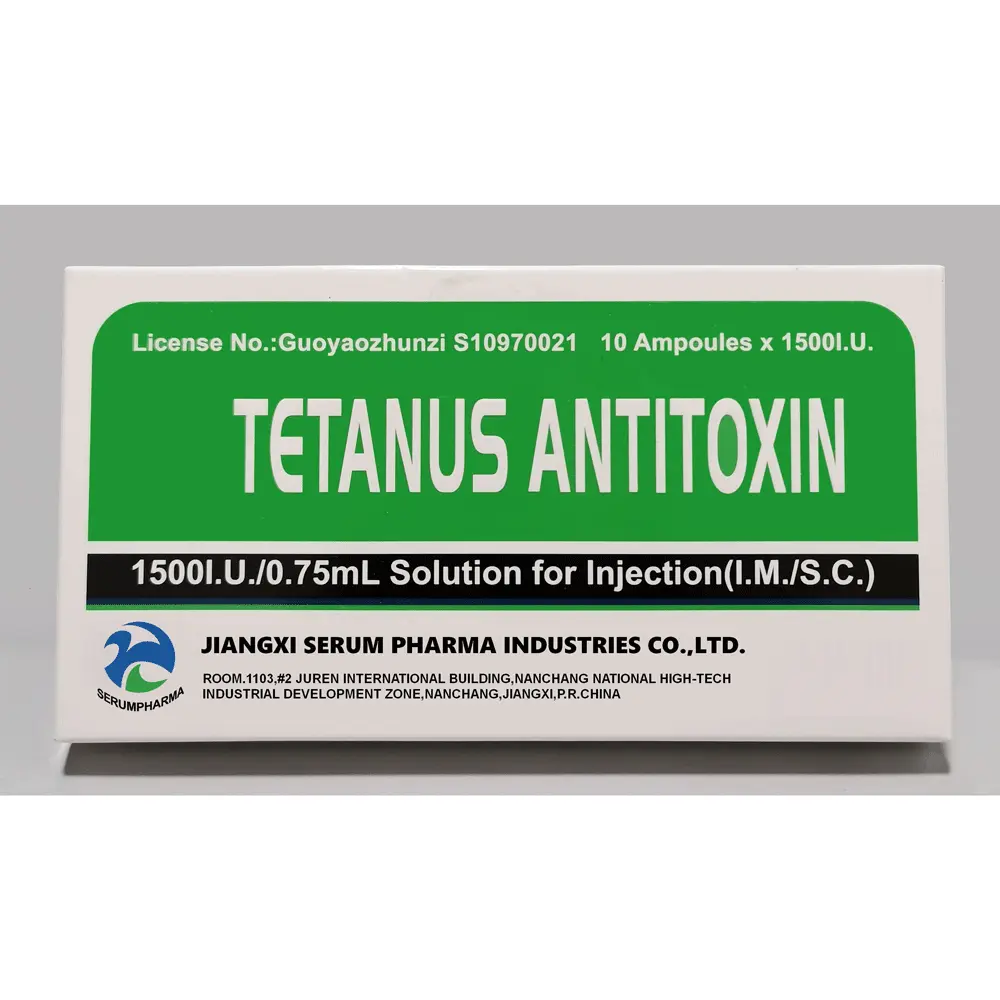
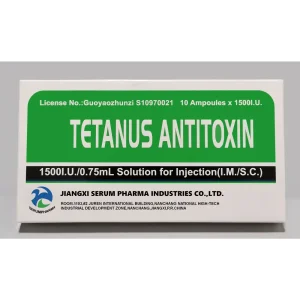
Specification: 1500IU/0.75ML 10AMPS/BOX
Trademark: Serumpharm
Support OEM/ODM: Yes
Mini. Order: 2000Boxes
Delivery Time: 30~60 Days
Trade Term: FOB,CIF
Payment Term: T/T,L/C
Standard Available: CP,BP
Documents: GMP,COPP,CTD
Indications:
This product can neutralize tetanus toxin and can prevent or treat tetanus.
Dosage and Administration:
Usage:
Subcutaneous injection should be performed at the deltoid attachment of the upper arm. When toxoids are injected at the same time, the injection sites must be separated. Intramuscular injection should be performed in the middle of the deltoid muscle of the upper arm or in the upper outer part of the gluteus maximus muscle. Intravenous injection should only be given to patients who do not respond to subcutaneous or intramuscular injection.
Intravenous injection should be slow, starting at no more than 1 ml per minute and then no more than 4 ml per minute. Intravenous injection should not exceed 40 ml at a time, and the body weight of children should not exceed 0.8 ml per 1 Kg. Antitoxins can also be added to glucose injection, sodium chloride injection and other infusions for intravenous drip. Prior to intravenous injection, heat the ampoule in warm water until it approaches body temperature. If abnormal reaction occurs during injection, it is necessary to immediately stop such reaction.
Dosage:
1. Prevention: 1500 ~ 3000 IU is injected subcutaneously or intramuscularly once, and the dosage is the same for children and adults; the dosage can be increased by 1 ~ 2 times in severe cases. After 5 to 6 days, if the risk of tetanus infection is not eliminated, the injection should be repeated.
2. Treatment: The first intramuscular or intravenous injection of 50,000 to 200,000 IU, the same dosage for children and adults; later depending on the condition to determine the injection dose and interval, the appropriate amount of antitoxin can also be injected into the tissue around the wound. Newborn tetanus, 20000 to 100000 IU intramuscularly or intravenously in divided doses over 24 hours.
Precautions & Warning:
1. This product is a liquid product. Products with turbidity, undispersed precipitation, foreign matter or cracks in ampoules, unclear labels, and expired products should not be used. Ampoules should be used up once opened.
2. Detailed records must be kept for each injection, including name, gender, age, address, number of injections, reaction after the last injection, results of this allergy test and reaction after injection, name of the manufacturer of the antitoxin used and batch number.
3. Injection appliances and injection sites should be strictly disinfected. The syringe shall be used for special purpose. If it cannot be used for special purpose, it shall be thoroughly washed after use, and dry roasting or autoclaving is preferred. For simultaneous injection of toxoids, the syringe must be separated.
4. Special attention should be paid to prevent allergic reactions when antitoxins are used. Allergy tests must be performed before injection and a detailed history of previous allergies must be asked.
Contra-indications:
It should be used with caution in patients with positive allergic reactions.
Adverse Reactions
1. anaphylactic shock: can occur suddenly during or within minutes to tens of minutes after injection. Patients suddenly present with depression or irritability, pallor or flushing, chest tightness or asthma, cold sweat, nausea or abdominal pain, fine pulse, decreased blood pressure, and severe coma and collapse, and can die rapidly if not rescued in time. Mild cases can be relieved after suprarenal injection; severe cases need infusion of oxygen, the use of vasopressors to maintain blood pressure, and the use of anti-allergic drugs and adrenocorticotropic hormone for rescue.
2. Serum sickness: The main symptoms are urticaria, fever, lymphadenopathy, local edema, occasional proteinuria, vomiting, arthralgia, and erythema, itching, and edema at the injection site. It generally develops 7 to 14 days after injection and is called the delayed type. It also develops 2 to 4 days after injection and is called accelerated. Serum sickness should be treated symptomatically, calcium or antihistamines can be used, and usually resolves in a few to a dozen days.
Storage instructions:
Store at 2-8℃, protected from light.